

November 4, 2026 | Dealership Marketing
Navigating the AI Inbox: What Every Dealer Needs to Know



Author: Caroline Student, Sr. Director, Predictive Marketing, automotiveMastermind
This article is Part 2 of our three-part series, The New Email Marketing Playbook for Car Dealers. In Part 1, we explored why traditional email metrics like open rates have become less reliable. The takeaway: dealerships need to focus less on opens and more on business outcomes.
Now, we’ll dive into how AI-powered inbox experiences are reshaping dealership email strategy.
For more than two decades, email delivery operated on a straightforward principle: if you sent an email at 9:00 a.m., it landed at the top of your customer’s inbox at 9:01a.m. Today, however, that largely chronological world is beginning to give way to dynamic inbox experiences that place greater emphasis on relevance and engagement. With the introduction of AI, such as Google’s Gemini in Gmail, the inbox has evolved into a more curated experience, helping users organize, summarize, prioritize, and interact with email content.
For automotive retail marketers, this is important to understand: Getting your email delivered to an inbox no longer guarantees that it will be seen. To maintain visibility and drive showroom traffic, dealerships need to understand how AI-powered inbox experiences may influence what customers see and how they engage with it.
From Chronological to Contextual: How the AI Inbox Works
In updated Gmail accounts, messages are dynamically categorized into tabs (Primary, Promotions, Updates) and may be prioritized within those tabs based on algorithmic relevance rather than timestamps.
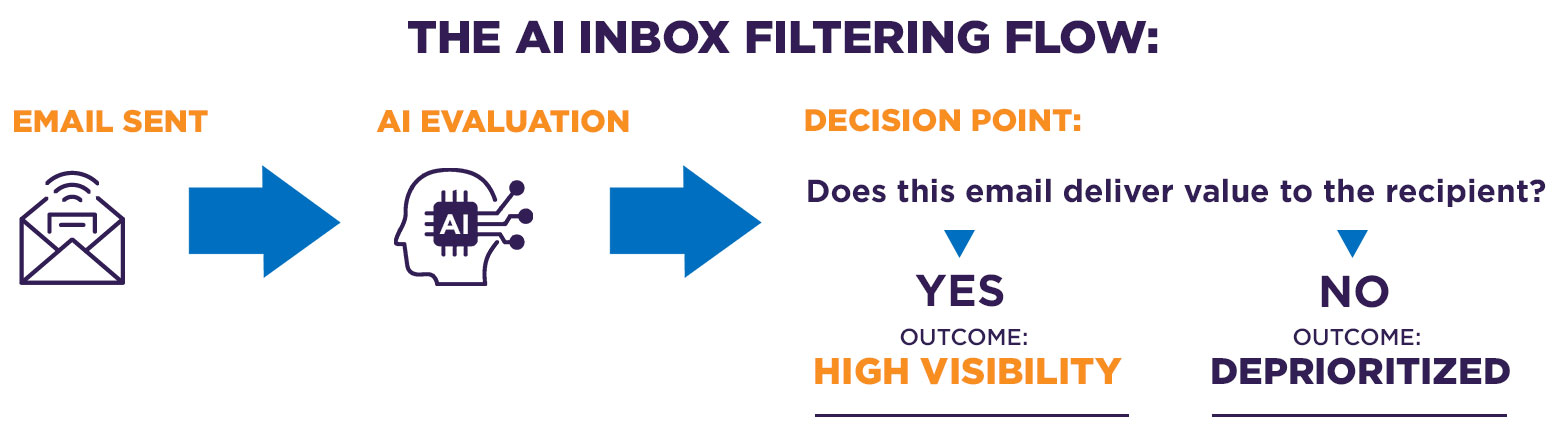
Signals That May Influence Visibility in Inboxes
While Google does not publicly disclose the exact methodology used across its inbox experiences, its AI-powered features are designed to help users manage growing email volumes and more easily find the information that matters most to them. As inbox experiences become more personalized, deliverability experts generally agree that recipient engagement and message relevance play an important role. In other words, relevant emails are more likely to earn visibility.
- Content Relevance: AI considers how an email is written and what it’s trying to say, helping separate messages that matter to the recipient from generic promotional content.
- Historical Engagement: The algorithm checks the recipient’s past behavior with your sender address (opens, clicks, replies, or unread deletions).
Inbox placement is dynamic based on the individual recipient:
| Placement Outcome | Qualifying Signal | Inbox Visibility |
| High Visibility Placement | High past engagement, concise value proposition, personalized offer | Primary tab or top of Promotions tab |
| Quiet Deprioritization | Repeatedly ignored sends, unread deletions, generic blast copy | Lower visibility in the Promotions tab or diverted toward spam |
AI-Powered Summaries: Why You Need to Communicate Value Quickly
One emerging trend in AI-powered inbox experiences is the ability to summarize lengthy email conversations and surface key information more efficiently. As these experiences become more common, marketers should assume customers may consume portions of an email’s value without reading every word of the message.
✦ Illustrative AI Inbox Summary Preview
“Your current lease on the 2023 Grand Cherokee expires in 90 days. We can offer you $0 down renewal options on new 2026 models.”
*Key takeaway: The customer receives the core message and value proposition before reading your email.
For example, if your email opens with three paragraphs of dealer boilerplate, generic greetings, and five competing banners, AI summaries won’t capture any of your value. If the summary isn’t compelling, the customer won’t bother reading your full creative.
Conversely, if your email communicates clear, personalized value in the first two sentences, the AI summary captures that intent, encouraging the customer to take action.
The Feedback Loop & The Cost of Irrelevance
In the AI era, every email sent has a cumulative impact on your dealership’s future inbox visibility. As a result, every interaction matters.
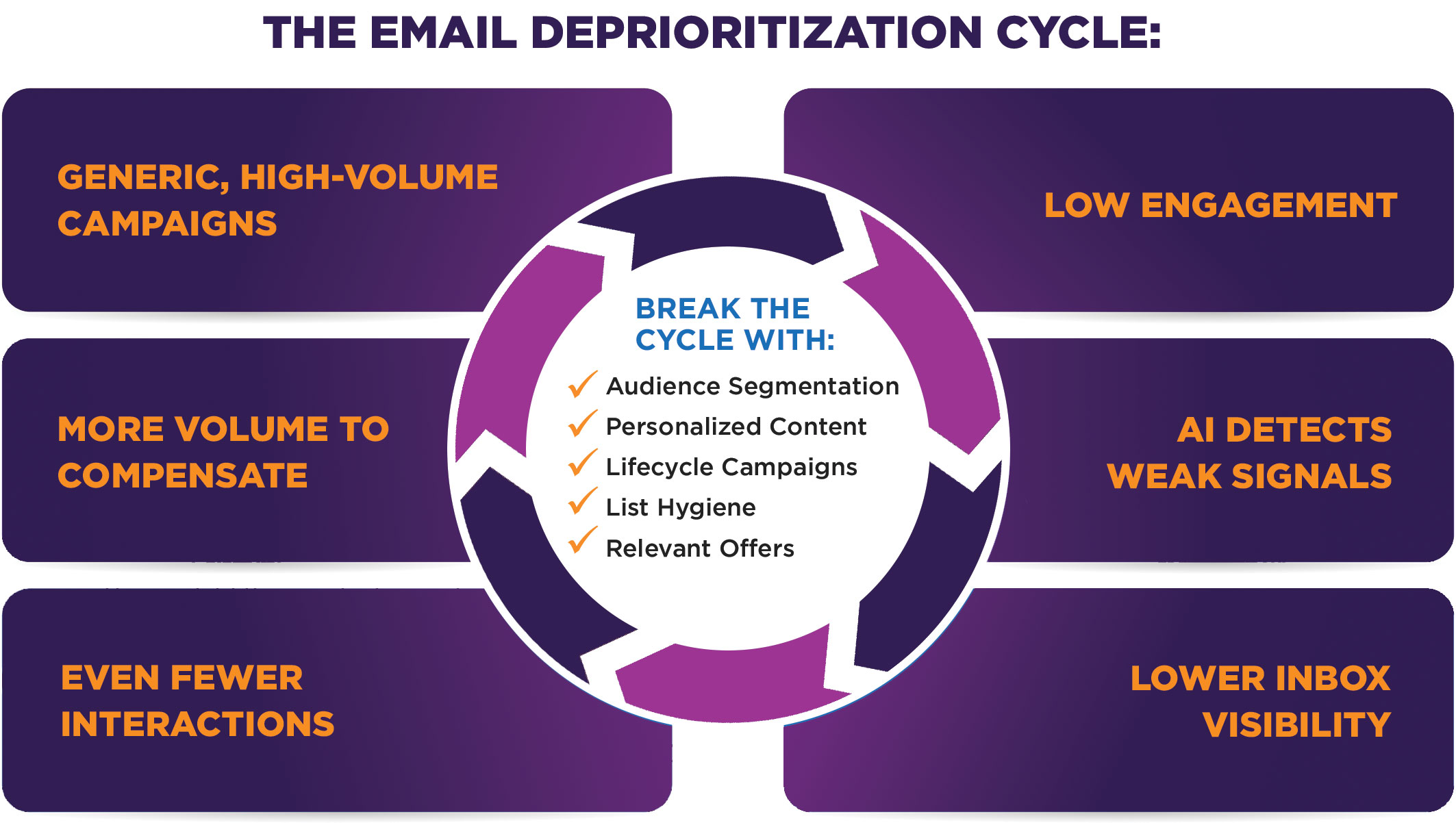
- Positive Actions Build Sender Trust: The action of a customer clicking a link or sending a reply creates a strong positive signal. Future messages to that customer are more likely to be recognized as relevant and placed where they’re easier to see.
- Negative Actions Compound Over Time: When a customer repeatedly ignores emails or deletes them unread, those actions can signal that your communications are not wanted. Future emails from your dealership may be deprioritized for that individual.
Therefore, sending high volumes of low-engagement emails can weaken marketing performance and may reduce future visibility among recipients over time. Instead, dealerships should focus on audience segmentation and lifecycle-based outreach.
How Dealerships Adapt: Writing for Multiple Audiences
Writing for today’s inbox requires optimizing for two audiences at the same time. Specifically, you need to consider both the AI algorithm that filters the message and the human customer who reads it.
1. Front-Load Value in the First Two Lines
Put the core message, offer, or action in the first 1 or 2 sentences of your email. This will help AI summarize your value.
- Instead of: “At ABC Motors, we pride ourselves on exceptional customer service and unbeatable spring savings on all new and certified pre-owned vehicles…”
- Write: “Your 2023 Honda CR-V is currently estimated to have $3,200 in trade equity. We have three pre-configured 2026 models ready for an upgrade with no change to your monthly payment.”
2. Focus on a Single Call to Action (CTA)
Emails with multiple competing CTAs (“View Inventory,” “Get Trade Value,” “Contact Us”) can create confusion. Instead, structure your email around one clear next step:
- One Primary Button: “Calculate Your New Monthly Payment” or “Schedule Service”
3. Encourage Customer Replies (The Ultimate Engagement Signal)
One of the most powerful signals that your content is valuable is a direct reply from the recipient.
- Action Item: Include simple, conversational prompts at the conclusion of your outreach:
- “Are you interested in seeing our current lease options for this month? Just reply ‘Yes’ to this email and our team will send over a personalized quote.”
4. Transition from Email Blasts to Lifecycle-Based Opportunities
Generic “Seasonal Sale” blasts sent to your entire CRM database trigger low engagement. Instead, align outreach with predictive life-stage events:
- Lease maturity milestones (12, 6, and 3 months out)
- Major equity cycle thresholds
- Overdue scheduled maintenance and safety recalls
5. Final Check: Ensure Emails are Easy for AI and Humans to Understand
Clear subject lines, straightforward copy, and a single explicit CTA perform better with AI summaries than vague or brand-heavy messaging. Before launching a new email, ask yourself:
- If this email were summarized into a few bullets, would the message be clear and accurate?
- Will AI understand my core value quickly?
- Will a human want to act on it?
The Bottom Line
This series began by examining why dealerships can no longer rely on open rates as the primary measure of email success. Now, we’ve explored how AI-powered inbox experiences may further reshape visibility by prioritizing relevance, engagement, and customer value.
The takeaway? More emails don’t necessarily mean more sales. As inboxes get smarter, dealerships that send relevant, well-timed messages will have a better chance of getting noticed, earning engagement, and turning interest into action.
In Part 3 of our series, Quality Over Quantity: Dealership Best Practices to Maximize Email ROI, we’ll focus on the practical changes dealerships can make today. We’ll cover how to improve list quality, reduce invalid and fake email records, build lifecycle-based audiences, and create more targeted campaigns that generate stronger engagement and sales outcomes.
Ready to Optimize Your Dealership’s Email Strategy?
Discover how automotiveMastermind’s predictive analytics and automated lifecycle marketing help your campaigns earn visibility in the AI inbox. Connect with our team to review your marketing and sales strategy.
FAQs
AI-powered inbox experiences can prioritize messages based on relevance, engagement history, and customer value. Dealers that personalize outreach and send timely offers often achieve stronger visibility and engagement.
Yes. Dealerships can improve visibility by front-loading clear, textual offer parameters (such as monthly payments, equity estimates, and deadlines) in the first two sentences, using bulleted lists, avoiding text locked inside image banners, and sending personalized 1-to-1 offers rather than generic mass blasts.
No. If a customer reads the AI summary directly from their inbox preview or lock screen and does not open the email, tracking pixels are not loaded and the interaction is not logged as a traditional “open.” This makes click engagement, direct replies, and CRM appointment bookings far more reliable measures of campaign success.
Strong automotive lead generation begins with identifying the right opportunities. Personalized outreach tied to ownership milestones, service needs, and equity events often produces higher-quality leads than broad promotional campaigns.
automotiveMastermind helps dealerships identify likely buyers, surface high-value opportunities, automate lifecycle marketing, and deliver more relevant customer communications through predictive intelligence and dealership software solutions.
No. While Google Gemini in Gmail is a primary driver (accounting for 62% of dealership databases on average), Apple Intelligence in Apple Mail (iOS 18+ and macOS) and Microsoft Copilot in Outlook perform similar summarization. The optimization strategies—front-loading value, scannable text, and personalized offers—work across all AI-enabled email platforms.